Start your estate settlement
Take this 60-second questionnaire to find out whether you qualify for an easier way to settle an estate.
Alix handles the probate work a lawyer would, plus the many estate tasks lawyers typically leave to you, like securing the home, locating accounts, stopping bills, organizing documents, and completing taxes.
More work done, often at a lower total cost.


Most families are surprised to learn that filing probate is only a fraction of estate settlement. Once probate is filed, there are still hundreds of tasks:







Court clerks can’t give you legal advice or fix your mistakes. One missed step can stall probate for months. Settling an estate usually takes 12 to 18 months, with hundreds of tasks along the way. That’s time most people don’t have.
With Alix, these tasks don’t fall on you.
When a loved one passes, no one hands you a guidebook. Suddenly, you're in charge of legal paperwork, unfamiliar court processes, deadlines, and financial decisions. All while managing your own grief.
By now you’ve probably already:




Court clerks can’t give you legal advice or fix your mistakes. One missed step can stall probate for months. On average, families spend 600-900 hours and 12-18 months navigating it all. That’s time most people don’t have.
With Alix you get:
With Alix, you don’t carry the risk or the workload. You stay the executor, but you gain expert legal protection and full estate support, all for one flat fee.


"Alix made the whole process so much easier and far less overwhelming. I even discovered bills I had missed after my father passed, and they helped me take care of them. Between working 65–70+ hours a week, raising a family, and managing a home, I didn’t have the time to handle everything alone. This service truly saved me countless hours and stress."
“We tried handling probate on our own, but it was just too confusing and stressful—we didn’t even know where to start. Alix stepped in, figured everything out, and got the ball rolling. Their Settlement Team has been so professional, helpful, and kind throughout the whole process.”
“As the executor of my mother’s estate, I was drowning in paperwork. Being able to send everything to Alix and knowing they would handle it all was life-changing. What felt impossible suddenly became manageable, and I could finally focus on my family instead of all the tasks."
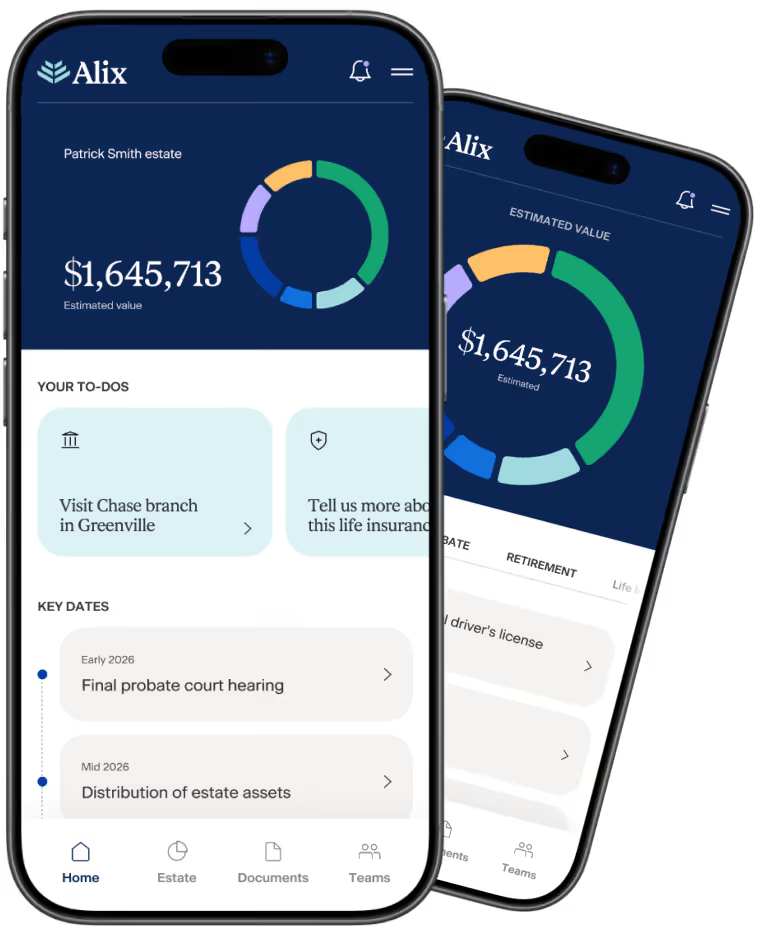
With the Alix app, you can track progress in real time, keep your family informed with individual logins and customizable access (up to 10 users), and get expert support , all in one place.
Settling an estate takes months and involves dozens of moving parts. The Alix app keeps everything organized and accessible, so you’re never left wondering what’s going on.
Court clerks can’t give you legal advice or fix your mistakes. One missed step can stall probate for months. On average, families spend 600-900 hours and 12-18 months navigating it all. That’s time most people don’t have.
Speak with an expert
Whether you need a probate attorney or a probate lawyer, Alix files your probate, and a licensed attorney is part of your plan where your state requires one. Then we handle the rest of the estate.
We prepare and file your petition, court forms and notices, and track every court deadline for you.
Hearings, court requests and rejected forms are handled for you, so your case keeps moving.
One flat fee covers probate and the rest of the estate, paid from the estate.
Court delays don’t turn into extra hours on a bill. You know the cost before you commit.
An estate expert will walk you through your options.
A simple probate can take 9 to 12 months, and settling the whole estate can take up to 12 to 18 months on average.* Here’s what happens at each stage, and what Alix handles for you.
Find the will, the assets, the debts and the heirs. Secure the home and order death certificates.
File the petition, get appointed and receive Letters, notify creditors and heirs, and give the court a full inventory.
Get an EIN, open the estate bank account, and move funds and titles into the estate.
Pay valid debts and estate expenses, then distribute what is left to the heirs.
File your loved one’s final tax return and the estate’s returns, with a CPA.
Ask the court to close the estate once debts are paid and everything is distributed.
*Timing varies by estate, county court and state. Some stages overlap. A licensed attorney is part of your plan where your state requires one.
Speak with an expert
If you’re reading this, you’ve probably just been handed one of the hardest jobs there is: settling the estate of someone you love, on top of everything else in your life.
I started Alix because families deserve certainty and real support when they need it most. So here is what we promise you:
A real team, with names and direct lines, works your estate from the first filing to the final distribution.
One flat fee, paid from the estate. No hourly bills and no surprise invoices.
You make the decisions. We do the legwork, and you can see every step in the Alix app.

Requirements vary by state and court. Alix organizes the records at every stage, and a licensed attorney is part of your plan where your state requires one.
Death certificates, the original will, trust documents, deeds, statements, family information and a first list of assets.
The petition, appointment papers, proposed orders, notices, consents, waivers and bond information when required.
Letters testamentary or letters of administration: the court papers that let you act with banks and other institutions.
Inventory, valuations, creditor documents, receipts, tax records, sale records and updates to beneficiaries.
Final accounting, distribution schedule, receipts, final petition, proposed order and discharge documents as required.

You stay the executor or court-appointed representative and make the decisions. Alix takes on the estate workload, and a licensed attorney is part of your plan if your state requires one.
A licensed attorney handles the legal work where your state requires one. Your Settlement Specialist handles the rest of the estate through one plan and keeps you informed.
The executor is named in the will. Without a will, the court appoints an administrator. Many states call either role a personal representative.
Dying without a valid will. State law then decides who inherits and who can serve as administrator.
A shortcut some states allow for smaller estates, so heirs can collect assets without full probate.
The county court that oversees the estate, confirms the executor and approves the final distribution.